In an old wooden chair, an 18-year-old boy sits, tears filling up his eyes. Fear overtakes him as the jury looks over him in anger and disgust. He believes he will be sitting in a different chair soon. A chair that he would not stand up from, a chair that would kill him. His father was found dead: maybe he did it maybe he didn’t, but now his life is out of his hands. He watches as his fate leaves with the 12 men jury. At this point, he will need a miracle.
12 Angry Men follows the twelve jurors as they discuss the innocence of an eighteen-y ear-old boy who was accused of killing his own father. Originally, the jurors feel the boy is obviously guilty, but they need a unanimous vote. Juror, one of two jurors given a name, Davis, refuses to vote the boy guilty after no discussion. Davis begins his argument questioning whether the knife that killed the father was the same knife the kid bought earlier the same day. The knife had a unique design, but Davis was able to buy the exact same knife from a different seller, proving anyone could have had that same knife. The other jurors are shocked by argument, but after a secret ballot, Juror 9, McCardle, switched his vote to not guilty.
Davis and McCardle go on to put other evidence into question such as two supposed eyewitness testimonies. Installing reasonable doubt into all the juror except juror 3. Juror 3 is passionate the boy is guilty without providing a valid argument; however, his guilty verdict is rooted in his rough relationship with his son whom he has not seen in years. The defendant reminds him of his son. Juror 3 stands alone for a while until he tears up a picture of his son in his wallet and begins to cry before proclaiming “not guilty.” The jurors then leave the room to bring their conclusion to the judge.
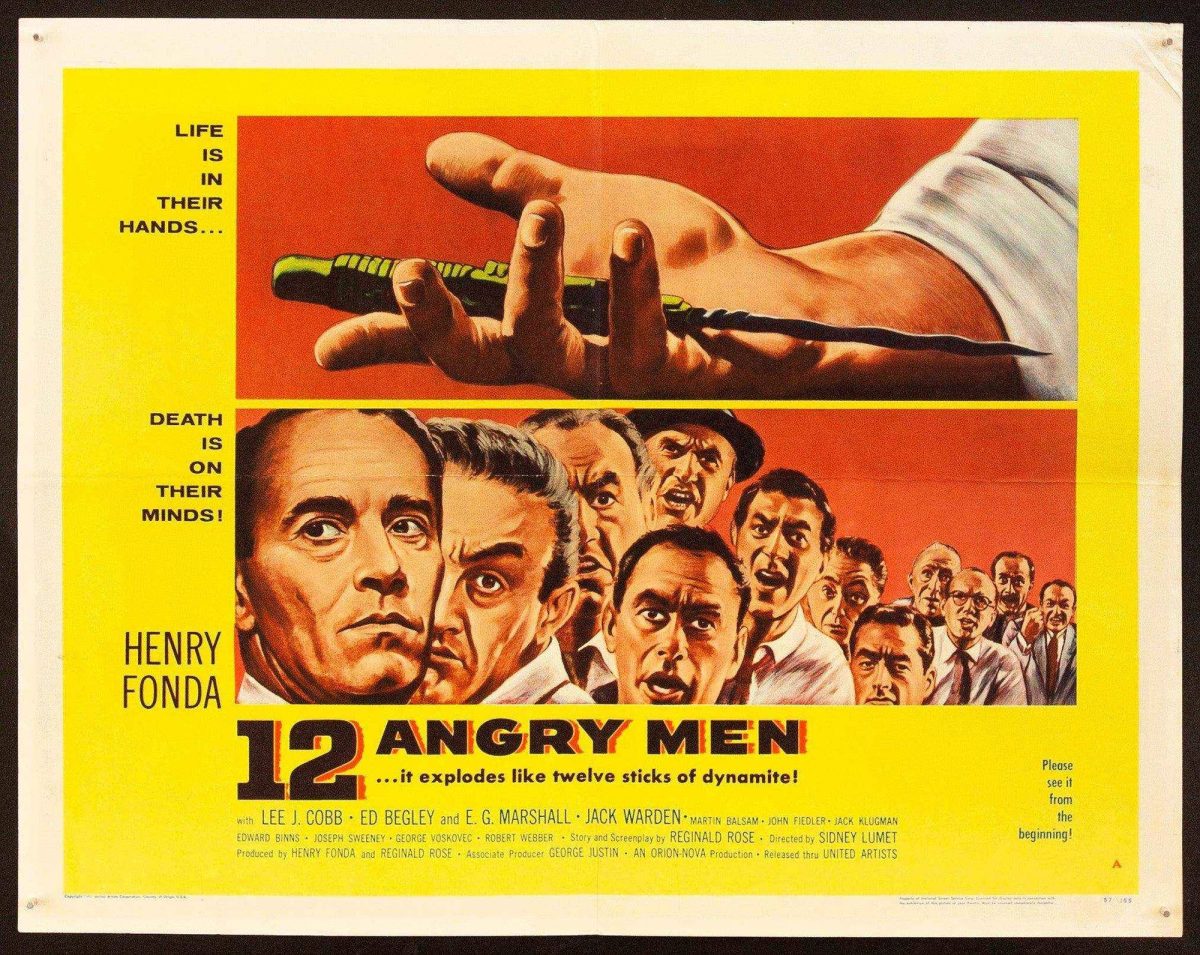
Reginal Rose originally wrote 12 Angry Men after being on a jury for a manslaughter case. Rose was displeased by the lack of passion the other jurors had for the case, believing there was not much thought put into the verdict. The film was originally much shorter because it was intended for television, but later, Rose along with star actor Henry Fonda recruited Sidney Lumet to make a full movie. This longer version of the story gives more nuance and depth to each of the character who give the movie its appeal.
The characters in 12 Angry Men are what makes the movie special. Most of the focus is on Davis as he goes against the crowd to prove the boy innocent. Davis has a respect the boy’s life that many of the other jurors do not have or are too timid to recognize. Specifically, Davis contrasts with Juror 3 since Juror 3 gives his own personal experience and gut feelings priority over the logic Davis brought to the discussion. However, Davis still shows compassion for his distressed adversary as Davis stays with Juror 3 as the others leave the room.
Two other characters that are foils for each other are Juror 7 and Juror 11. Juror 7 is extremely uninterested in the case and simply want to go watch a baseball game that same day. Juror 7 switches his vote to not guilty because he hopes it would let him leave faster. Juror 11, who voted not guilty, is angered by Juror 7’s unenthusiastic switch. Juror 11 is an immigrant watch maker who appreciates American Democracy and court system which Juror 7 takes for granted.
Two of my favorite characters are Juror 2 and Juror 4. Juror 2 is shy and timid, but as the film progresses, he becomes more confident in standing up for his opinion and stands up to other Jurors. Juror 4 is one of the last three to switch their initial opinion. However, unlike the last two Juror 4 only bases his opinion on facts. He is willing to hear and consider any argument that is presented. He is logical and thinks for himself, but he is willing to change his opinion. Juror 4 heavily contrast with Juror 10 who is the second last to change his mind. Juror 10 doesn’t listen to any arguments and is prejudice towards the defendant because he is from the “slums.” He lets his prejudice show in a final speech where Juror simply tells him to sit down and shut up.
The whole movie is mostly confined to one room so the tension between the characters builds up fast. The one room explains how the movie could be filmed on a small budget of $337,000 (close to $4 million in today’s money). The filming only took 21 days, but rehearsing was happening weeks before filming was even considered.
The father’s murderer is never revealed; however, after a lackluster performance from his lawyer, the boy must be shocked that he was able to stand up from his old wooden seat as a freeman. Maybe the boy did kill his father and lived out a life of crime, or maybe an innocent kid was given the opportunity to live his life to the fullest. However, the boy’s innocence is not important to the overall message of the movie. That human life should be respected, and prejudice and lack of interest do not belong in our justice system.